Friday, February 21, 2020

Getting Children to "Listen" when it's time to do Chores

     Image result for kids chores

     Research shows that kids who have household responsibilities are more likely to step up and help others outside the home.  So why don't kids help more, and what can you do about this challenge in your own home?


Image result for kids chores

     The main work of children is actually play.  Many times we forget that children have not yet developed their executive functioning skills which allow them to plan ahead, initiate tasks, follow a series of directions, stay on task, get organized, persevere through challenges, utilize good time management, and draw from their working memory, etc.  

     When our children fail to do as we ask and chip in to complete chores, it often helps to take a step back and see if we are providing the needed steps and guidance to get their compliance.  Here are some effective ways to teach life skills through understanding brain development and the importance of your relationship: 


Image result for eye contact

1.  Get in close proximity to your child before you ask your child to help with a task.  Create eye contact with the child, perhaps bend down to their level or touch their shoulder, and have them look at you.  It is easier for them to ignore your audio request from a distance.  


Image result for eye contact

2.  Give specific directions rather than asking children to do something vague.  "It's time to make your bed and put the dirty clothes in the hamper" versus "I told you to clean your room."

3  Ask the child to repeat the directions before proceeding on.  "Please tell me what you heard.  What is being requested of you?"  


Image result for eye contact

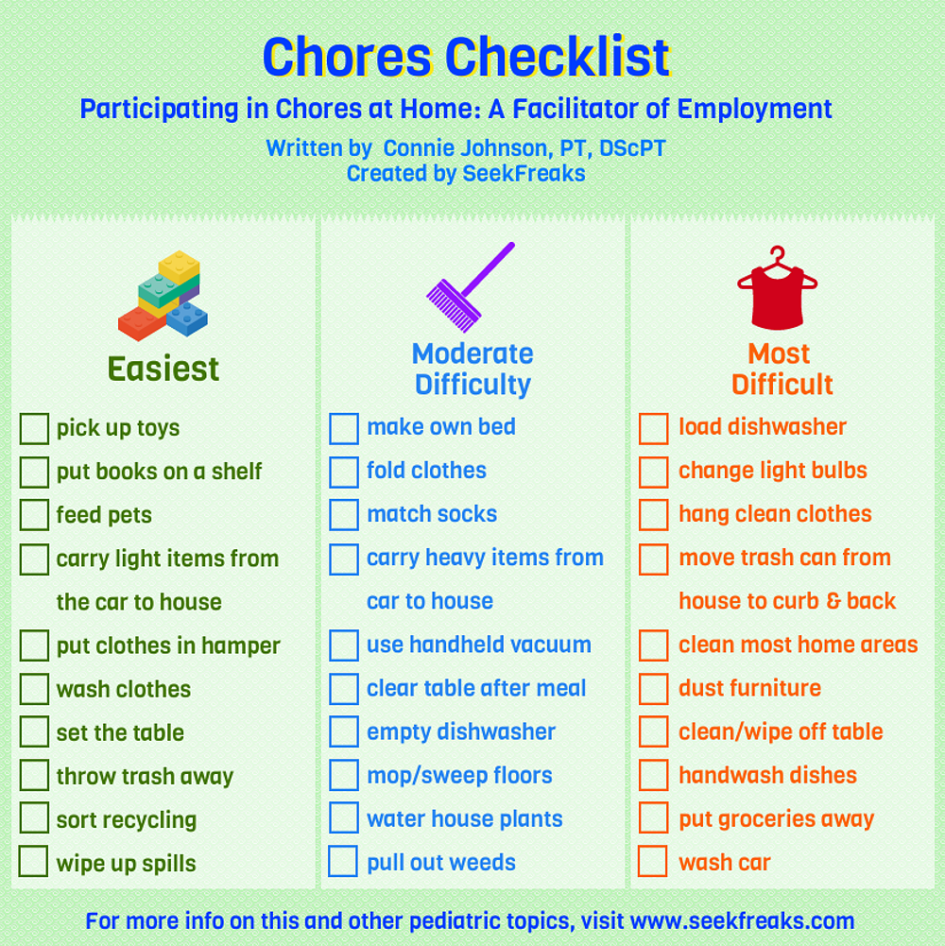
4.  Make a visual list of steps to accomplish.  Providing a list gives something concrete for the child to refer back to.  Some kids like to check off items along the way.  Try calling them contributions instead of chores.  This wording focuses the child on how they can be an integral part of taking care of their family.  


Saturday contributions:  
1.  Feed the cat  
2.  Bring your dirty clothes to the laundry room  
3.  Vacuum the living room 
4.  Come get a big hug from dad 💛

5.  Model what you want your child to do, then have them try it. You can't really expect your child to do a job as well as you would.  You probably weren't so thorough at his age, either.  So...demo, demo, demonstrate.  Many of us learn best when we can experience the directions. Think about the reason you want your child to help ~ it's to learn life skills and to experience how good it feels to contribute.  Expect to spend time teaching and supervising.  Consciously involve your child in what you're doing from an early age, even though it takes much more time.


Image result for chores

6. Give your child a moment to transition from what they were doing into what you want them to do.  For instance, 

 "Wow, that looks like fun.  I see that you are in the middle of a game, but the dog is begging for you to take her for a walk.  You can play one more round and then let's break to take the dog before finishing the game."  

7.  Give one direction at a time.  Break a big job into smaller steps so it doesn't seem overwhelming to your child. Help your child master each step.  Perhaps, take photos of them doing it and make a small poster with each step visualized.  Once your child takes responsibility for a task, try to minimize your control over that task.  Instead of redoing a job she has done, focus on the positive aspects of what your child has accomplished.

8.  Turn your request into a game.  Make it fun to cooperate with your request.  "Let's see if we can act like orangutans while washing the windows?"  Or, "Let's play beat the clock.  I'll set the timer and we'll see if we can get these jobs all done in 20 minutes."  Experiment with being silly and playful and ridiculous about reminding your child about their chores, until everyone is laughing about the dishes getting cleared from the table.  Your anxiety will disappear, and any power struggles will disappear too.  And once there's lightness and fun about it, you might even find that your kids no longer need prompting, says Dr. Laura Markham (ahaparenting.com)


Image result for chores

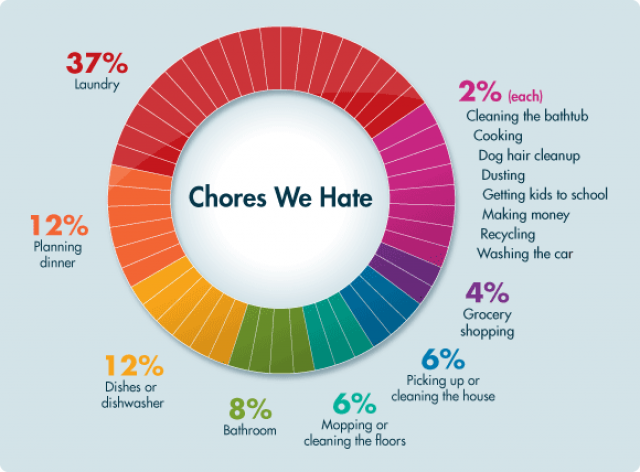
9. Even adults hate some chores.   Give kids choices whenever possible.  "You can pick one easy task and one longer job from the contribution list today.  You decide which two tasks you want to accomplish before lunch."  Providing choice and sharing power are very motivating to any age human. 


Image result for chores

10.  Do chores together whenever possible.  Set aside a time of day when all family members are working on chores.  Buddy up, sing silly songs, and get 'er done.   Recognize that your child doesn't see much intrinsic value in household work, unless she's doing it with you.  Instead of sending her off to work by herself, see the work as an opportunity to bond with her.  Play her favorite music and sing along.  Find the joy in working together, and inspire your child with it.


Image result for kids chores

11.  Give praise after they have followed through.  "Thanks so much for helping our family get everything done today!   You rock!"


Image result for chores


    When parents want their children to "listen", they often really mean they want them to "obey."   The above-mentioned approaches help a child's developing brain follow through more easily with what is being asked of them.  See if any of these paths get your family closer to where you would like for them to be?

Friday, February 14, 2020

Practice Deep Listening to develop Empathy in Children

     Students at Nederland Elementary have been working to develop more Empathy for others.  They are:   
           ~observing facial expressions, body language, situational clues & the tone of voice
             utilized,
           ~offering gestures of kindness and compassion,
           ~listening with their whole bodies so they can reflect the underlying feelings of
             others,
           ~asking curious, open-ended questions to clarify their assumptions and thoughts.

     Children require a great deal of coaching in these areas and need adults to model these strong social skills in order to build the neural pathways that access empathy and compassion in their Wizard Brains.

     One tool we use at NES is to teach listening with our whole bodies.  This concept goes far beyond hearing words with our ears to encompassing listening to nonverbal cues with our eyes, quieting our hands and feet so we can listen without multitasking, using our brains to listen for the underlying feelings and needs of the speaker, not interrupting with our mouths and then responding by repeating, summarizing, or asking open questions to learn more.

  Image result for whole body listening

How often do we adults find ourselves using phrases with children such as "pay attention" or "listen carefully"?  When we make these requests, we may not realize that we're giving kids an unspoken expectation that we want them to stop whatever they are doing and show us they are listening with their whole body.  However, do we ever really teach them all the components of what whole body listening looks like?  If not, when the child doesn't show those behaviors, we feel frustrated and assume they don't want to comply.  Listening skills must be broken down into concrete, explicit steps in order to help children understand the "how" and "why" of listening.  Young children will enjoy learning these steps in Can you listen with your eyes?  by Nita Everly or in the video Whole Body Listening with Larry


           In order for children to develop effective listening skills, we need to practice deep listening with them.  When we are truly listening to our child, our immediate response isn't advice, minimizing the situation, or offering solutions.  These responses get in the way of our children regulating their emotions and coming up with their own solutions to life's challenges.  Your child needs your full attention and your empathy to develop their own empathy and problem-solving capabilities.    Ahaparenting.com and ConfidentParentsConfidentKids.org offer these parenting tips for Deep Listening with your child~

1.  Remember that all your child's behavior is communication.  
     How do we listen to a shy, quiet child or to a defiant one?  Even children who don't say much want to connect with you.  Accept it on their terms.  A handshake, a hug, a long look in each other's eyes, a high-five or a playful pillow fight may be as meaningful and full of connection as a deep conversation.  Observe your child's behavior and think about what they are communicating to you.  What need are they trying to meet?  What emotion are they expressing?  If your child isn't obeying, consider how you can give them choices and empower them to do what you are asking:  Instead of saying "I've asked you three times, do it now!"  Re-frame your request and empower the child by giving choices inside of the expectation:  "Would you like to do it on your own or have me help you?"  Or, "would you like to leave now or have ten more minutes?"  Finding ways to give limited choices to a defiant child, or be playful while getting a job done, helps children "listen" to the request instead of digging in their heels.

"Every message is beautiful if we hear need behind it." ~Marshall Rosenberg


2.  Pay full attention.
     When your child is ready to share, the shopping list and that problem at the office can wait.  Your child knows when you're really listening.  She may not show it, but it breaks her heart when you pretend to and don't.  Turn off your cell phone.  Really.  She will remember for the rest of her life that her parent turned off the phone or screen just to listen to her.


3.  Use Conversation Starters rather than Conversation Closers.
     Culturally, we tend to be in the habit of not using feeling words.  Conversation openers acknowledge and reflect feelings without judgement or suggestions, rather than shutting down feelings.  Questions may have the potential to put the other person on the spot and cause defensiveness.  Use questions, not to probe, but to clarify your assumptions and inferences --
     "You sure sound angry at your brother...Is that how you're feeling tonight?"   versus  "Why are you so grumpy?...You just have to make more of an effort to get along with your brother."

4.  Don't Take it Personally as you listen to your Child Rant.
     When children get upset, they sometimes retaliate in an argument with hurtful words like "I hate you."  Try not to take those statements to heart.  Though they are intended to wound in the moment, they are coming from a feeling of lack of control.  Walk away and take time to cool down.  In calmer moments, discuss how those words are painful and coach your child to rephrase how he is feeling without harming others.  "Could you say instead, 'I hate what you did.  I hate what you are doing?'  The goal is to listen for the feeling underneath the rant and focus their words on the action not the doer of the action.


5.  Reflect Feelings and Needs instead of probing.
     "Tell me how you feel" is not empathy.  Empathy is mirroring whatever your child is already telling you.  "You seem sad this morning" or "You're very quiet tonight...maybe you need a little down time?" reflects the emotions and needs underlying what you are seeing and hearing.

6.  Use Words that Validate your Child's Experience.
     If you have listened deeply, your response reflects their experience.  Say just enough to validate their perspective when your child has had an unpleasant experience -- "No wonder you're upset" or "Nothing seems to be going right for you today."  When kids feel their emotions are understood, the feelings lose their charge and begin to dissipate.


7.  Don't put your child on the spot.
     If you would love for your child to open up more to you, see if they share when you aren't looking directly at them.  Your child may feel more comfortable talking while driving in the car, doing dishes, or walking down the street.  Sometimes when we turn the lights out at night, kids pour out  their souls to us in the dark.  Make some of those opportunities happen and see what follows.

Image result for driving with a teenager

8.  Don't start Solving their Problem.
     The point is to listen in such a way that lets him get past his upset so that he can begin to think about solutions himself.  Kids learn most from the opportunity to hear themselves talk and come to their own conclusions.  Facilitating a child's thinking in this way can support him in internalizing thought processes that lead to responsible decision- making.  For instance, instead of saying "Be careful,"  ask him "What do you need to remember when you play at the park or get ready for school, or...?"  Engage their critical thinking skills by having them re-state the rules, steps, or precautions that have been given.


9.  Listening isn't the same as Obeying you.
When it feels like children aren't "listening" to your direction, try front loading the situation using specific guidelines and boundaries to create clear expectations.  Or instead of saying, "Be quiet! Stop yelling!" after things have gone haywire, re-frame in the positive and give specific directions to coach them to do what is expected:  "Please take a moment to take a deep breath, then you'll be able to either whisper or talk softly to say what you want."

10. Cultivate a deeper Understanding of what is Normal.
     Because so often our greatest challenges with our kids stem directly from their developmental struggles to learn what they need to, learning about children's development deepens our understanding of them.  We will listen and respond differently to their behavior when we understand what is perfectly normal for a child of their age.  Check out the free resource -- NBC Parent Toolkit

Image result for nbc parent toolkit

     There may be no greater demonstration of love than DEEP LISTENING.  Practice listening with empathy to truly understand your child's thoughts, feelings, and needs.  When you model empathetic listening skills, it helps your child identify and accept their emotions, regulate the intensity of them, learn to listen to other's perspectives, and eventually think about how best to problem solve.

Wednesday, February 5, 2020

A Parent's Guide to Listening to What is Unsaid


     The winter months are tough on most of us ~ long, dark days, high winds that keep us indoors more than we wish, the weight of the world, and the ongoing needs of our families.  The winter months can seem long and gloomy sometimes ~ even in Colorado.  Here are a few ideas that can help us Care for Our beleaguered Selves and bring more Love and Light to our Children. 💕💕💕


1.  Let's start with the Well-Being of moms.  

     Our bodies are screaming for healthy nurturance and we may be ignoring their strong announcement.  When women were surveyed by Women's Wellness, asking how they felt about the state of their health, the results were kind of shocking. Only 2% said they felt great about their health.  What unspoken message is your body trying to tell you?  Moms used these phrases to describe what their bodies were telling them:


My hormones are out of whack.
I feel bloated; I'm tired of digestive struggles.
My emotions feel all over the place.
I don't feel rested when I wake up.  
My skin looks dull, I have bags under my eyes.
I don't have enough energy to get through the day.

     Moms are people with needs too.  As women, we may be amazing at looking out for other people.  We are nurturers; caregivers.  But sometimes, we're so busy taking care of all the details, and those around us, that we forget to love on ourselves.  Listening to our bodies helps us make the necessary changes in our lives to care for ourselves and become more emotionally-grounded and present for our children.


     2.  What is saving your life right now?  

     ModernMrsDarcy.com shares:  I know I'm not alone in my winter struggles.  It's never an easy time of year.  I'm always tired, and missing the daylight, and dealing with a house where someone has the flu.  To beat back the gloom, I'm focusing in on the things ~ big or small ~ that are saving me right now.  Most of us know what's killing us, and can articulate it, if asked.  But few of us pay attention to what's giving us life, what continues to fill our cups so we can be our best with our children.

     I didn't realize how often the same strategies and small graces have helped me survive the winter season over the years:  getting outside for exercise and fresh air, drinking buckets of hot tea, enjoying the occasional sunny days, buying fresh flowers...  When I think about what's saving my life this winter, my mind is readily drawn to the foundational things:  eating well, walking the dog, going to bed on time, spending time with good books.  Lately I've been turning to jigsaw puzzles not just because they are fun, but because they're helping me think, even on days when that feels difficult, or the problems at hand feels intractable.  I begin the morning with a dose of therapy from my light box to address seasonal affective disorder.  I end my days with some flickering candles or a wood fire.  I'm also trying to take the long view of things ~ it helps by showing me that every year I get walloped by winter sickness, and every year spring comes again and we get over it.  

     Take a moment to ponder "what is saving my life right now?"  Make sure you weave these simple, healthy things throughout each day and evening.  

     If being with dear friends gives you positive energy to get through the winter, host a
"dirty house party" and invite everyone to bring some of their leftovers to share.  Do not vacuum up the dog hair, hide the piles of papers, or clean the bathroom before everyone arrives.  Savor true friends who love you, and your less-than-perfect mess, for who you are.  


3.  Trade parental busyness for spoken and unspoken gestures of love for your children.

     Have we become so busy that we have forgotten to pay attention to what gives life meaning and joy?  According to Maggie Dent, if 'hurry' is problematic in your life and you have a to-do list that is beyond reality ~ there may be something deeper that needs addressing.  When we hurry to fit everything in, maybe our expectations for ourselves, our partners and our precious children is too high and too unrealistic.  (This is where the crabby, shouty person is triggered!)  Listen underneath your anxiety and grouchiness to see if saying 'no'  to some of life's demands would help lower your stress level.  Make a list of things you can stop doing ~ and things you can do less often.

     Dent also recommends several easy ways to slow down and create more meaning for your family through rituals and routines:  
   
     ðŸ’—  A few minutes before your child's bedtime, step outside to say goodnight to the stars and moon.
     ðŸ’—  Create a "go slow PJ weekend morning" routine.
     ðŸ’—  Drink your first morning beverage slowly ~ savoring the taste, temperature and smell.  
     ðŸ’—  Start and end each day noticing three things you're grateful for.  
     ðŸ’—  Make micro-moments of CONNECTION by building a "love bridge" between yourself and your child as you help them reflect on their day:  

                                  Image result for parents loving children
    
      Here are some precious everyday gestures which show love to your children (instead of just driving them around from one appointment to another):
     ðŸ’•  When saying goodbye to your child each morning, kiss their hand and tell them to hold onto that love all day.
     ðŸ’•  Have your child capture a kiss from everyone in the family, including the dog, and store it in a jar in their room.  Refresh it as often as needed.
     ðŸ’•  Touch your child tenderly every time you walk by them.  Tousle their hair, squeeze their shoulder, hip bump or high five them.  Wink at them when you see them.  Nonverbal communication is just as important as verbal expressions of love.
     ðŸ’•  Put funny photos or love messages on the mirror in the bathroom your child uses.
     ðŸ’•  Use bedtime to remind your child how much they are loved.  Cuddle up for a story, give them a hug, or repeat your favorite "I love you to the moon and back" saying.  
      ðŸ’•  If you had to reprimand your child before bedtime and everyone is feeling lousy, wait until five minutes after your child has gone to bed and perform a "surprise bedroom attack."  Leap from the doorway, gently tackle them and surprise them with a tickle, tummy fart, or quick wrestle.  This lets them know you love them no matter what.

     Dr. Laura Markham (ahaparenting.com) reminds us that children become resilient, not when they are loved, but when they feel loved.  Use rituals, routines, gestures, and nonverbal communication to express your profound love for your child.  They will listen deeply to what is unsaid.  

                                                 Image result for parents loving children

     This week, students at NES are mindfully noticing the nonverbal communication of others ~ facial expressions, body language, tone of voice, and volume of speech.  They are learning to read beneath the words of others to uncover the feelings that are often unspoken.  If we parents listen to our bodies, pay attention to what is saving our lives during these cold, winter days, and slow down to focus on what gives meaning to our lives, we will have sent a nonverbal message of love and resilience deep into our child's psyche.