Saturday, January 23, 2021

Parenting ~ You Don't Have To Do This Alone.


          As the winter winds gusted through the foothills, several dozen local parents piled upon their couches in front of their fireplaces and "tuned in."  They connected virtually during the interactive Mountain Strong Families Series hosted by TEENS, Inc.  January 21st kicked off the first virtual session of Raising Whole Human Beings.  Four more monthly sessions will follow.

     TEENS, Inc Parenting Educator, Angie Sands, shared how she raised her son as a young, single mom.  She remembers searching out resources to build her confidence and skills, and to strengthen her relationship with her son.  Like the mountain parents gathered online, she realized she needed to surround herself with the strength and experiences of other parents to raise her own son well.


     Sands began this current Mountain Strong Families Series with helping us think about what behaviors we find challenging in our children, then helping us to reframe those behaviors into positive qualities we hope our children will one day exhibit.  Parents were then asked to think about the skills they will need to explicitly teach if they want their children to develop those very qualities.  Each family set some personal goals for their children.  


What qualities do you want

to see your child(ren) develop?


All parents want to raise children who are whole and healthy, but a lot of things can get in the way of that. One of the best scientific predictors for how well any child turns out is whether at least one adult is emotionally attuned to and consistently shows up for them. "Showing up" goes beyond the basics of functional parenting ~ where someone feeds, clothes, transports their child, and gets them to do their homework. "Showing up" is about intentionally being present with our child. It's about regularly connecting to the child's inner world in order to strengthen the ties between parent and child.


     The four building blocks for raising healthy children have been laid out by Dr. Dan Siegel and Tina Payne Bryson, PhD in their book, The Power of Showing Up.  Children who feel like they are seen, soothed, safe, and secure form a connected relationship with their caregiver and learn to thrive.  We parents were asked to reflect upon which adult in our own childhood saw and understood our inner world, made us feel safe, soothed our emotional reactions, and repaired the relationship when ruptures occurred?  It might have been a parent, or a relative, coach, neighbor, teacher or elder who showed up through thick and thin.  These nurturing relationships helped shape how our brains developed -- either becoming integrated or remaining dysregulated and reactive.  

     Who in your life helped you feel
seen, soothed, safe, and secure?

Parents at the MSF session were given four principles to ensure we become this solid, secure base for our children. The four parenting principles include:

a. Intentional activities that help us CONNECT daily with our child,
b. Focusing on the CAREGIVER'S WELLBEING,
c. CHASING THE WHY behind our child's behavior so we respond to their needs and emotions, and
d. Serving as a COACH to explicitly teach emotion-regulation and social skills rather than punishing our child for not having these skills yet.


Children who consistently have a caregiver show up in these ways, learn to trust in and relate to others, feel comfortable in their own bodies and with their feelings, and respond to their emotions, relationships, and life challenges without becoming overwhelmed or shutting down. Children who don't feel secure, build brains that are more likely to react to other people with drama, neediness, or demands. Recent neuroscience research shows how our relationship with our children helps determine how their brains actually form and whether they will feel whole or insecure throughout their lives. However, it is never too late to develop these healthy pathways in our child's brain.

Angie, the facilitator, offered three key parenting skills for filling our child's need for connection and teaching social-emotional skills that will serve children for a life time. First off, every parent was asked to designate 10-15 minutes per day participating in child-directed play or "special time" with each of their children. By playing and observing closely what our child imagines, creates, or is absorbed in, and by using descriptive commentary to let them know we see their inner world, we are building the foundation for a secure, attached relationship with our child.


A second parenting strategy is to make sure we are intentionally affirming our children 5 - 10 times more than we correct, redirect, or critique their behaviors. It's easy to get into the rut of constantly correcting our child's missteps, but the adult's critical voice soon becomes the child's inner voice. We want our children to believe in their self-worth, because children who feel good about themselves are more likely to interact with others in healthy ways.


Thirdly, parents were challenged to find simple ways of connecting with our children throughout the regular routines of the day. For instance, purposely turning off cell phones in the evening and having dinner conversations about "how were you kind today?" or "how were you brave today?" Parents of older kids might begin a conversation journal with their child to pass back and forth with each other. There are endless ways for weaving connection activities into our regular morning and evening routines that do not take more time. They just take our focus and intention.

After setting our own intentions regarding these strategies, we were asked to notice over the next month how our relationship with our children (and our children's behavior) is affected by these efforts. Whether you are attending the virtual Mountain Strong Families Series or not, you can set your intentions to improve daily bonding with your child. And you can find additional resources regarding these parenting strategies on the new Mountain Strong Families Facebook page. Next month, we will focus on "Nurturing Ourselves on the Parenting Journey." Until then, Happy Parenting!


Wednesday, December 2, 2020

Give "Presence" to Children this Holiday Season


     Life has been crazy and stressful this year.  Holiday traditions and expectations can add to that.  Or, we can choose to focus on what genuinely creates happiness and contentment as we enter this season.  "Connection, meaning, and contribution produce warm and pleasant feelings, not things," we are reminded by Dr. Laura Markham in Ahaparenting.com  During a rough year, our children are primarily craving the stability and love that we give them.  

    Some families choose to decrease the buying frenzy over the holidays by limiting their children to four presents and helping children talk about the difference between "wants" and "needs".  Children are encouraged to generate a holiday Wish List with "something I want, something I need, something to wear, something to read."


     But Dr. Laura Markham actually encourages parents to take the focus off of presents this year and put it back on the love between you and your child.  This year especially, we may be struggling to make ends meet, but consumerism isn't what fills our children's emotional cups.  Since children spell love "TIME", Markham says "make love tangible by coming up with magical ways to connect" after a particularly difficult year.  Her suggestions are:

     1.  Give the gift of your time.

Print out certificates for activities with you and wrap them so your child gets the pleasure of opening a present.  For added excitement, create a treasure hunt with clues hidden around your house and the certificates located at the end of the hunt.  Kelly Holmes from Happy You, Happy Family, offers a Free Printable Coupon Book that will delight your child like no other gift.  Your child can cash in on fun (often free) experiences throughout the long, dark winter and beyond.  You might end up spending a whole day in your jammies, making playdough together and forming things while its warm, or taking a mental health day off school and work (yes, please!)


Check out this coupon book chocked full of fun ways to connect and make any time of the year special.  Printable Coupon Booklet


      2.  Share the magic of the holiday.  

No matter what holiday you celebrate (it's a great time to learn about these Beloved Holidays around the world), find a sense of wonder by going for a quiet walk together as a family and look at neighborhood lights, icicles, and animal tracks.  The fresh air melts away stress, the dark night inspires awe, the novelty and sense of adventure on an evening hike create connection.  Turn off all cellphones and just enjoy the moment with your family.  


     3. Shift the focus from materialism to connection and giving.

Photograph you and your child making homemade presents, decorating for the holiday, or baking treats.  Create a little book of holiday tradition photos along with your child.  They will enjoy the memories it brings back every time they look at it.  Brainstorm with your child how you could gift a neighbor this year -- help shovel, deliver kindling, share a treat, clean off their car, carol at their door, or call them weekly until it's safe to leave our homes.


     4.  Start a blessing bowl to experience the gift of gratitude.  

Over the next few weeks, write down things you and other family members are grateful for, from this unusual year.  Toss them into a "Blessing Bowl."  Ask your children to contribute, too.  One evening toward the end of 2020, make popcorn, snuggle up by the fire, and go through the bowl reading each gratitude item aloud.  Talk about them together.  Savor the feeling of emotional abundance served up in this bowl.  Share how blessed your family is to have each other.  This creates feelings of gratitude, connection, and meaning which lasts for months.  


And here's one SPECIAL, FREE present for YOU:

Mountain Strong Families is hosting a five-part virtual Parenting Series this winter entitled:  How to Raise Whole Human Beings.  If some of your child's behavior is distressing to you, if having everyone home often feels overwhelming, if you'd love to connect with other mountain families, and learn more about a Positive Parenting approach to teaching your child Social Emotional skills, stay tuned for more details.  Mark your calendars:  Thursdays Jan 21, Feb 18, March 11, April 8, and May 6th.  This Series will feel like a much needed, nurturing gift to all the adults who are helping their children cope with the added challenges of 2020!!


Tuesday, November 10, 2020

How Do We Raise Anti-Racist Children in Nederland?


     "I don't even know where to start," sighed one young mom at the Becoming an Anti-Racist Family workshop on November 5th, 2020.  Since many of us still grow up in segregated schools, churches, and neighborhoods, "we don't even know what we don't know," admitted another parent.  "My first college roommate was black and that was the first time I ever really talked to anyone in-depth about what it meant to come from a different background than my own,"  acknowledged another mama.

     It is hard today to talk about racism in our homogeneous mountain town, but that doesn't mean that white parents can't intentionally prepare their children to be actors and allies in a diverse world.  We don't have to wait for people of color to lead the charge.  We can begin the process with our families.  But "I fear being accidentally racist," chimed in one mom.  In spite of the challenges, local workshops like this one are a chance to help each other learn and grow as we work to create a world for all children based on racial equity.


     As Mountain Strong Families gathered virtually, local mom and workshop facilitator -- Sara Sandstrom -- thanked parents of toddlers to teenagers for engaging in uncomfortable conversations about racism.  The goal of this TEENS, Inc sponsored workshop was to give parents tips for raising children who will not continue to perpetuate racist ideas and actions, or to uphold racist policies.  "We teach social emotional skills to children for multiple reasons," said organizer Ann Sherman, "both to help kids nurture their own wellbeing and to give them the awareness and skills to create a society where everyone's wellbeing is supported."

     Parents will need to understand the complex structure of Racism (racial prejudice combined with a system of power and privilege) in order to explain it to their children.  Sandstrom helped illustrate three types of Racism.  Most of us are aware when Interpersonal Racism rears its ugly head.  We may have family members or acquaintances who make derogatory racial comments, crack hurtful jokes, or seem oblivious as to how their actions perpetuate ongoing segregation and racial inequities, i.e. when they make decisions about voting or where to live, shop, or attend school.  Interpersonally, we hear folks complaining about the attempts there have been made to balance the wealth and power between racial groups (because when you are used to being privileged, equality can feel like oppression to you.)


     Cultural Racism was then explained as "representations and messages that behavior and values associated with whiteness are 'better' or 'normal' compared to those associated with other racial groups."  From news to Disney movies, images of racial groups shape our thinking.  Some cultural examples Sandstrom offered included the idea that black men are dangerous and black women are too mouthy.  "My mom would always lock the car doors as we drove through 'bad' neighborhoods," remembered one young dad.  The English language is also full of phrases that associate white with goodness (i.e. white lie) while blackness connotes something bad (i.e. blackmail).  Parents were challenged to intentionally counter these cultural and media images by reading books with their children which have black protagonists who illustrate black achievements and resistance to oppression.  And to overcome stereotypes by surrounding their children with diverse art, toys, movies, friends, and experiences.  


     George Floyd wasn't our wake-up call.
Blacks have been sounding the same alarm for decades
and we keep hitting the snooze button.


     Black lives are cut short every day, not just by the brutality of some bad cops, but from all kinds of institutional policies and practices.  Statistics shared about Institutional or Systemic Racism revealed to attendees that publicly-funded school districts which are attended predominantly by children of color receive $2226 less per student than districts where mostly white children attend, Blacks are 25 times more likely to die of cancer, and the legacy of slavery as well as the practice of "redlining" neighborhoods has allowed the median white family wealth to grow to 41 times more than the median wealth of black families.  Racism resides in our Institutions when unfair policies and practices across various systems (such as housing, banking, education, criminal justice, healthcare, and religion) routinely provide unequal access to goods, services, and opportunities for people of color and advantages for white people.  Teaching kids to be nice to everyone is a start, but it doesn't alter the institutional policies that negatively impact black families.  The cycle of inequity keeps being reproduced.


     Our children will automatically be growing up in a society rife with racist images, ideologies, and institutional policies.  We are being socialized and impacted all the time, whether we know it or not.  So, how do parents raise an Anti-Racist child -- someone who realizes the history of racial inequity and works to end it?  The answer is obviously -- be very intentional.

      Sandstrom shared some of our nation's history of white supremacy and then encouraged parents to -- Start young.  Talk with young children about the concept of "Race" by using books like The Skin We Live In.  After acknowledging differences and similarities, point out racial injustices to your child by discussing what is "fair/unfair", using books like Not My Idea  or Something Happened in Our Town.  Share history, context, and provide media literacy skills with older children.  Suggest they read Stamped or This Book is Anti-Racist.  Parents practiced conversing with their child about racism and realized how hard it is to explain all this.  Particularly since we live in such a homogeneous area, parents realized the need to intentionally place their families in close proximity to people of color in order to listen to their experiences and perspectives.


     "My parents often didn't speak up so that they could avoid conflict," one dad said.  "I feel like I need to speak out.  I have earned a lot of privileges I never asked for."   It is hard for many whites to believe that they are "privileged."  We may be struggling to pay the bills too, or affected by gender, our class background, health issues or other hardships.  However, "White Privilege" doesn't mean that your life hasn't been hard; it means your skin color isn't one of the things making it harder.  Parents began to grapple with the idea of using their privilege to be Anti-Racist while raising their children.  To receive a list of suggested Action Steps, Books and Movies, and Parenting Tips, contact ann@teensinc.org.

     As the workshop ended, attendees wanted more.  More ways to educate themselves.  More ideas to utilize with their children.  More chances to talk about this topic and support each other on their journey.  Is there anyone out there who would like to host an ongoing group for a bunch of motivated Anti-Racist families?   There are kids to raise and more anti-racist work to be done in Colorado.  


Monday, September 21, 2020

Fostering your Child's Healthy Sexual Development


     When parents gathered virtually for the Mountain Strong Families presentation "Fostering Your Child's Healthy Sexual Development" on Sept 17th and 24th, it quickly became apparent that many had received little information or shaming, guilt-ridden messages about sex while they were growing up.  Some of us experienced sexual abuse which inevitably will also influence the sex talks we need to have with our kids.  To be expected to talk openly and honestly with our children about sexual topics leaves many parents feeling overwhelmed, embarrassed, or reactive.  How do we discuss sexuality with confidence and help our children develop a body positive approach to their sexual development?  

    Trish Wood and Gretchen Fair, from Blue Sky Bridge in Boulder, spoke with Mountain Strong Families about having tough conversations with our children regarding all sorts of sexual topics.  They shared several powerful reasons why parents should make an intentional effort to talk about sex with their kids --

     a. Children may be able to get factual information from other sources, but family is often the primary source for helping to develop an individual's sense of values around sexuality.  

     b. Children whose parents talk to them about sexuality are more likely to delay intercourse, are more likely to act responsibly when they do become sexually active (Martinez, Abma, & Copen, 2010) and are safer from incidents of sexual abuse.  

     c.  Talking about sex and sexuality is the missing link in preventing a whole bunch of problems later in life ~  low self esteem, depression, guilt, body image problems, increased risk of sexual abuse, teen pregnancy, transmission of STIs, etc.    


     Parents were encouraged to start by reflecting upon which messages you got when you were a child about sexuality?  What messages did you receive about bodies, babies, and gender roles?  Hmm.  Stop for a minute and do your own reflection before reading on.  What did you learn and how did it affect your sexual development?  

     Where did you get your information about sexuality from -- parents, peers, faith organizations, books, siblings, relatives, school?  Some of us got a "drive by" approach as a book was handed to us without further explanation or discussion.  Some received information about the mechanics and biology of reproduction, but nothing directly about relationships or sexual pleasure.  We might have received information about puberty for our own gender, but not necessarily about the other genders.  Did you learn about obtaining consent, birth control options, self pleasure, body image, sexual orientation and identity, healthy relationships, pornography, sexual objectification, assault, sexual politics, or how to define your own values regarding sexuality?  Maybe not.  And that was before the Internet.  Now our children have online access to both facts and distortions, regardless of any conversations we have with them.  By age nine, most kids have seen pornographic content online.  Boys, in particular, say they learn more about sexuality from porn than from their parents.  


     Parents must be intentional about sharing accurate information and their values with their children.  If you stop and think about all the devices that are used to get online, and all the places children can get access to the Internet,  you realize that availability of sexual information is Everywhere!  Learn how to use parental controls on every device if you don't want your elementary-age child to accidentally be exposed to adult sexual content.  It should be noted that if parents offer accurate information to kids, children are less curious about scrolling online to learn about sexual topics.  

     Here are some helpful hints for parents wanting to guide their child's healthy sexual development:

1.  Clarify what your own values are regarding sexuality.  Your values are the one and only thing you can teach your kids that no one else can.  When you are clear about your sexual values, the conversations become easier.  Your partner's values may differ from yours and that's fine.  Your children will eventually develop their own values, so it's okay for both of you to talk about your perspective.  


2.  Get the facts.  Check out some books or websites designed to teach children of various ages about sexuality.    From It's NOT the Stork!  A book about girls, boys, babies, bodies, families and friends (age 3 - 6) by Robie Harris and Michael Emberley, to It's So Amazing!  A book about eggs, sperm, birth, babies and families (age 7 - 9), to The Girls (Boys) Body Book:  Everything You Need to Know for Growing Up YOU!  by Kelly Dunham et als, to It's Perfectly Normal; Changing Bodies, Growing Up, Sex and Sexual Health (ages 10+), to Spare Me the "Talk"; A Guide to Sex, Relationships and Growing Up (age 13+) by Jo Langford, there are many books that can help with this process.  

     Understanding what is typical sexual behavior at each age and stage will also help you feel more confident and less reactive about your child's developing sexuality.  For instance,  

     Human beings are sexual beings from birth.  Our largest sex organ is our skin and children like to be held and caressed.  Babies begin to explore their genitals to self-soothe.  Toddlers begin to develop either a positive or negative body image, and become curious about naked bodies and gender identity.  From age 4 -6, children start wondering where babies come from, they mimic adults by kissing or holding hands, and they often play "doctor."  In early elementary school, children start talking about having a boyfriend or girlfriend, develop a deeper understanding about gender roles, may use slang words about sexuality, tell jokes about body parts, and draw nude pictures.  From age 8 -12, children look to media and peers for sexual information, compare themselves to peers in physical development, become sexually attracted to others, and usually define their sexual orientation and gender identity.  By 13, children may be considering or engaging in behaviors that are sexual in nature with their peers.  Children are naturally sexual beings.  Exploration and curiosity is normal. 


3.  Decide what you want your kids to know.  Make a list of topics, prioritize them, and practice addressing the easier ones first.  Start sharing information when your child is in preschool and build upon it as they mature.  Use the correct names for body parts.  To protect your child, make sure noone keeps "'secrets".  By age 5, simply explain the process of reproduction, discuss what body parts and practices are "private."   By age 8, share your values and rules.  Discuss adult sex with your child before their peers share derogatory words and play games of dare.  Ask your child "where did you hear that word and what do you think it means?"   Before children attend middle school, they should have a basic understanding of just about all sexual topics.  Spend a lot of time from age 8 -12 talking about respect and consent.  Help your child to read and interpret the body language of others.  Have conversations in the car when they are a captive audience.  From age 13 on up, give kids permission NOT to do what others are doing sexually.  Let them use you (their parent) as an excuse to get out of uncomfortable situations they may not be ready for.  Be open about sexual activity and the precautions that need to be taken.  If your child is uncomfortable talking to you, help identify other adults who can talk with them about sex.  


4.  Stop, breathe, and think though what you want to say.   The conversation will go better if we are calmly responding to the topic instead of having a knee-jerk reaction.  Practice, practice, practice the conversation.  If need be, circle back to a topic that you were caught off-guard by.  Merely say, "Remember when....,  let's talk more about that."  


5.  Initiate the conversation.  Use every day teachable moments when reading a book, watching a movie, or hearing song lyrics to talk about consent, gender roles, healthy relationships.    Start early and make these conversations a natural part of your family life.  Keep the talks short and sweet.  The parents who have the most impact on their kids have regular conversations about sexuality, love and relationships and are very close to their children.  Repeat yourself over and over with more detail as your child ages.    

   One resource for parents who want to have better conversations with their kids than they had is:  birdsandbeesandkids.com with Amy Lang.  Her podcasts, book suggestions, and parenting tips help ease these difficult conversations and prepare parents for this important responsibility.


Wednesday, September 2, 2020

Simple Strategies for Creating Sanity during Remote Learning (PART TWO)

               The Four Pillars of Stoicism. Understanding Stoic acceptance… | by Caleb  Ontiveros | Stoicism — Philosophy as a Way of Life | Medium

       With Covid-19 and societal instability as a backdrop, your child may be responding to the start of school in a dysregulated state.  Uncooperative behavior, meltdowns, and intense emotions are to be expected from your child (and maybe even yourself as you manage your new role in home learning!)   To turn things around, copy what teachers do all year long ~ attend to the social emotional needs of your child.  Parents can draw from the myriad of simple strategies your child's teacher pulls from her toolbox every year to engage anxious, frustrated, and unmotivated children.  

   In Part One, we covered strategies from the first two pillars below.  This week, consider how to utilize strategies aligned with the last two pillars of responsive teaching methods.  Each of these necessary pillars provides specific ways to soothe children and regulate their nervous systems so they can become curious and enthusiastic learners this year!

     1.  Ensuring your own personal wellness (because self care is NOT selfish!)

     2. Creating predictability and fun routines.

     3.  Creating a strong bond with your child while ensuring their sense of safety, and

     4.  Helping your child regulate their emotions and behavior.  


 3.  Create Strong Bonds and a Sense of Safety at Home.  Teachers will be working their darndest to get to know and bond with your child virtually.  But how will you maintain and strengthen your bond with your children during this challenging time?  How will you decrease the fear and anxiety in your home that interferes with learning?  How will you remain your child's rock through this lengthy storm?  Above all, and before stressing academic learning, insure your relationship with your child is rock solid.  

     a.   Work on being super present with your child.  Children often act out when they are craving needed attention from the folks they love.  One way to fill this need is by observing your child when they are working or playing, and intentionally making positive comments about what you are noticing.  Turn off your phone or other devices when interacting with your child.  They will feel your positive presence instead of noticing that you are consistently critical, distracted or multi-tasking.

     b.  Do emotional check-ins with your child.  Ask your child to name how they are feeling once or more each day.   Ask them to expand on what may be causing them to feel that way.  Just being aware of and naming our emotions helps regulate the nervous system.  And an empathetic response from a parent about whatever the expressed emotion is... works wonders.  

     c.  Express confidence in your role as parent and teaching assistant in front of your child.  Let your child hear you say, "We've got this.  We just need to listen carefully to the directions, make a plan to get it done, and ask for help when we don't understand.  I expect you to give this your best effort each day and I will too."  Your expressed confidence will help your child feel secure.  

    d.  Do not watch the news when your young children are within hearing distance.  The unfiltered weight of the world is not appropriate for children to have to process.  If you need help explaining the racial tensions in our nation, plan to attend the Nov. 5th Mountain Strong Families workshop "How to Be an Anti-Racist Family".  If  your young child seems to be reacting to the weight of the world, help redirect them toward something they CAN control and create by sharing this simple song "Turn off the News" by Lucas Nelson:


   e.  Request a 1-on-1 virtual office meeting between your child and their teacher so they can begin to get to know each other better.  Share personal information about your family with the teacher and ask questions to learn to know them better, too.  Consider sending the teacher a video message of your child asking any questions they have about assignments instead of asking the question for them.  

                                             Letter to Teacher About ADHD Student: At School

     f.  Make sure your child has plenty of safe interactions with their classmates and friends.  Kids can get many of their social needs met at the beginning of the school day during a fun interactive morning meeting with their entire class.  Later in the day, your child will connect to learn in small groups with their peers.  But if they are still starving for friendship time, set up virtual friendship connection groups or lunch bunches with Althea.Abruscatto@bvsd.org, allow your child to have zoom calls with friends, or see if anyone is interested in being a pen pal who is willing to exchange weekly messages through the mail.  Kids will still enjoy playing virtually or reading to each other online (or even with grandparents!).  Fill your child's cup with some safe, meaningful social interactions.

     g.  Try to have family suppers together most nights (with screens turned off).  Tell jokes, share what you are grateful for, and ask curious questions about each other's day.  Quality family time goes a long way toward creating a strong family bond.  Even if you are working nearby your child, stop to have a lunch date together.  Share what you both have been working on.  

Family Dinner Conversation Starters for Kids


4.  HELP Your CHILD REGULATE their EMOTIONS.  Humans tend to react to (or mirror) the emotional energy that others give off.  All children need "coached" by adults to calm themselves when things aren't going well.

     a.  Work to stay calm when your child starts to get wound up by lowering your voice, taking 3 deep breaths, and pausing before responding to their resistance or whining.  Purposely SLOW YOURSELF DOWN and you will radiate calm energy to your distraught child.  

     b.  When your child gets upset or can't focus any longer,  engage in calming techniques TOGETHER.  Use what is referred to as a "TIME IN" by breathing or coloring together for five minutes instead of a "TIME OUT" where your child is separated without knowing how to regulate themselves.   Sit nearby and coach your child to hug themselves, gently rock back and forth, and breathe deeply together.  Go outside for a bit, or go to the window together, and look for 5 things you can see, 4 things you can touch, 3 things you can hear, 2 things you can smell, then get a drink of water and notice how it tastes.  

Self-hug! | Beautiful children, Photo, Beautiful smile

     c.  Practice various calming and coping strategies daily (even before you need to do them in real life).  Some tools include listening to music, journaling about feelings, self-hugs, deep breathing, and exercise.  These strategies naturally align your child's developing prefrontal cortex with their reptilian brain to aid in emotional regulation.  Build these strategies into your daily school or bedtime routine.

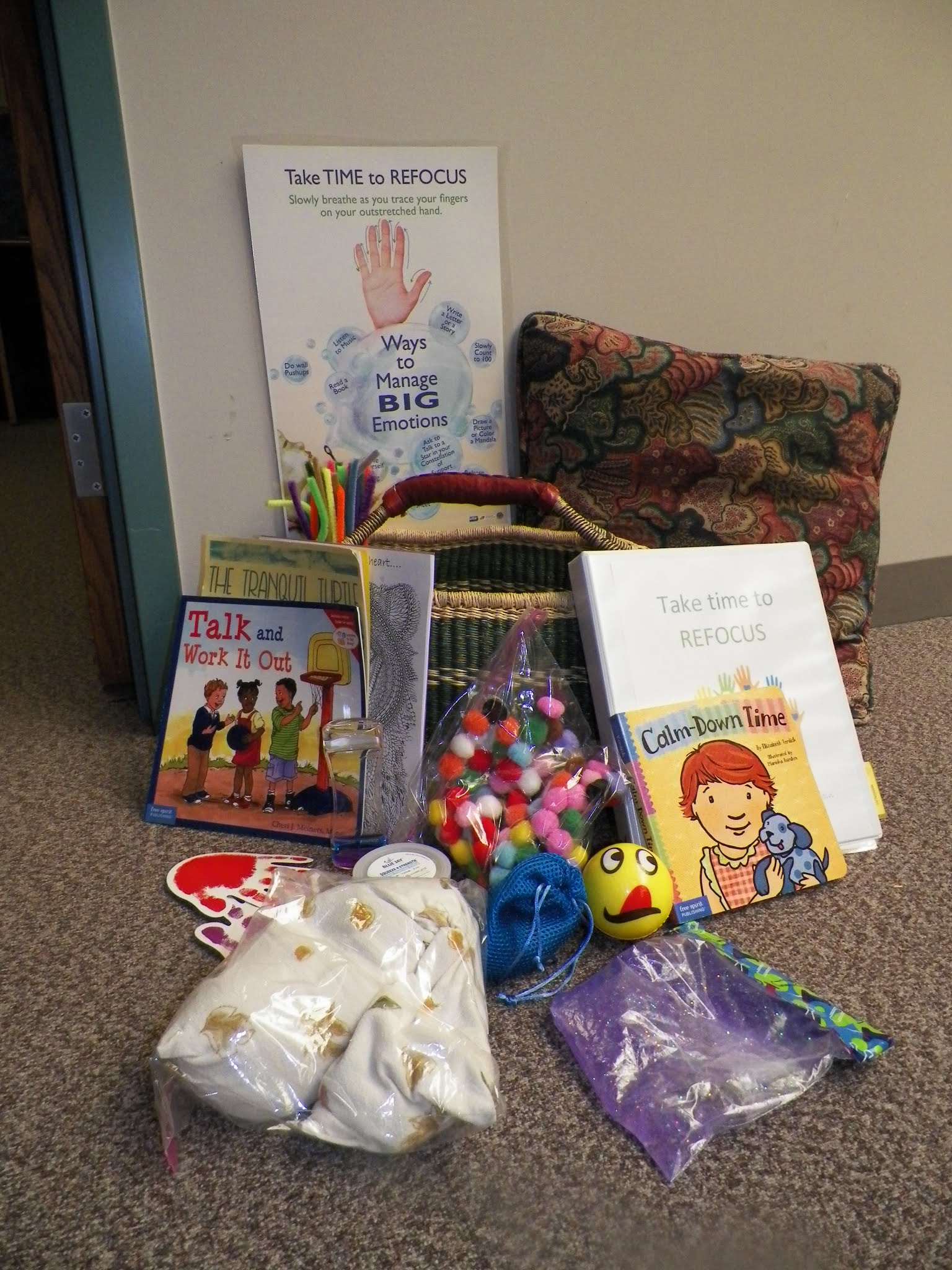
     d.  Set up a calming space somewhere in your house with some soothing items in it.  Encourage your child to seek out this space for 10 minutes when they need a regulation break to reset themselves for further learning.  It might include items such as a liquid timer or glitter jar, Hoberman's sphere, aroma therapy, stuffed animals, or mandalas to color.  Your child has a similar set up called a "Refocus Center" in their classroom.  Learn how to set up and use a Calming Corner at home in:  Establishing a positive tool for learning emotional self-regulation at home


     e.  Get outside EVERY day.  Fresh air, nature play, and exploration help us all feel refreshed and grounded.  Have free play, scavenger hunts, water fights, fort building, bird watching..... whatever fun our mountain weather permits.

     These practices are what teachers incorporate into the school day in order to reach and teach every child.  Teachers know that addressing anxieties and big emotions have to happen before other learning can take place.  All the caregivers who are now being asked to help with academics can use these same strategies to heal the uncertainty and chaos that is swirling around your children at this time.  Try one or more concrete steps under each Pillar and watch your child relax into a more optimistic and motivated mindset while displaying increased cooperative behavior.  

     These strategies help rewire their brain and nervous system so they can learn and grow.  However, don't expect overnight success.  A typical classroom of kids takes several weeks to settle into a routine each fall (pre-pandemic).  But by boosting each of these pillars in your home, remote learning will become easier to swallow for you and your child.  It might even become your child's best school year yet as they partner with their teacher and their parent in a whole new integrated way.  Feel free to contact us with questions or more information about these Four Pillars (kristen.kron@bvsd.org  or ann@teeninc.org).  GOOD LUCK!