Monday, September 21, 2020

Fostering your Child's Healthy Sexual Development


     When parents gathered virtually for the Mountain Strong Families presentation "Fostering Your Child's Healthy Sexual Development" on Sept 17th and 24th, it quickly became apparent that many had received little information or shaming, guilt-ridden messages about sex while they were growing up.  Some of us experienced sexual abuse which inevitably will also influence the sex talks we need to have with our kids.  To be expected to talk openly and honestly with our children about sexual topics leaves many parents feeling overwhelmed, embarrassed, or reactive.  How do we discuss sexuality with confidence and help our children develop a body positive approach to their sexual development?  

    Trish Wood and Gretchen Fair, from Blue Sky Bridge in Boulder, spoke with Mountain Strong Families about having tough conversations with our children regarding all sorts of sexual topics.  They shared several powerful reasons why parents should make an intentional effort to talk about sex with their kids --

     a. Children may be able to get factual information from other sources, but family is often the primary source for helping to develop an individual's sense of values around sexuality.  

     b. Children whose parents talk to them about sexuality are more likely to delay intercourse, are more likely to act responsibly when they do become sexually active (Martinez, Abma, & Copen, 2010) and are safer from incidents of sexual abuse.  

     c.  Talking about sex and sexuality is the missing link in preventing a whole bunch of problems later in life ~  low self esteem, depression, guilt, body image problems, increased risk of sexual abuse, teen pregnancy, transmission of STIs, etc.    


     Parents were encouraged to start by reflecting upon which messages you got when you were a child about sexuality?  What messages did you receive about bodies, babies, and gender roles?  Hmm.  Stop for a minute and do your own reflection before reading on.  What did you learn and how did it affect your sexual development?  

     Where did you get your information about sexuality from -- parents, peers, faith organizations, books, siblings, relatives, school?  Some of us got a "drive by" approach as a book was handed to us without further explanation or discussion.  Some received information about the mechanics and biology of reproduction, but nothing directly about relationships or sexual pleasure.  We might have received information about puberty for our own gender, but not necessarily about the other genders.  Did you learn about obtaining consent, birth control options, self pleasure, body image, sexual orientation and identity, healthy relationships, pornography, sexual objectification, assault, sexual politics, or how to define your own values regarding sexuality?  Maybe not.  And that was before the Internet.  Now our children have online access to both facts and distortions, regardless of any conversations we have with them.  By age nine, most kids have seen pornographic content online.  Boys, in particular, say they learn more about sexuality from porn than from their parents.  


     Parents must be intentional about sharing accurate information and their values with their children.  If you stop and think about all the devices that are used to get online, and all the places children can get access to the Internet,  you realize that availability of sexual information is Everywhere!  Learn how to use parental controls on every device if you don't want your elementary-age child to accidentally be exposed to adult sexual content.  It should be noted that if parents offer accurate information to kids, children are less curious about scrolling online to learn about sexual topics.  

     Here are some helpful hints for parents wanting to guide their child's healthy sexual development:

1.  Clarify what your own values are regarding sexuality.  Your values are the one and only thing you can teach your kids that no one else can.  When you are clear about your sexual values, the conversations become easier.  Your partner's values may differ from yours and that's fine.  Your children will eventually develop their own values, so it's okay for both of you to talk about your perspective.  


2.  Get the facts.  Check out some books or websites designed to teach children of various ages about sexuality.    From It's NOT the Stork!  A book about girls, boys, babies, bodies, families and friends (age 3 - 6) by Robie Harris and Michael Emberley, to It's So Amazing!  A book about eggs, sperm, birth, babies and families (age 7 - 9), to The Girls (Boys) Body Book:  Everything You Need to Know for Growing Up YOU!  by Kelly Dunham et als, to It's Perfectly Normal; Changing Bodies, Growing Up, Sex and Sexual Health (ages 10+), to Spare Me the "Talk"; A Guide to Sex, Relationships and Growing Up (age 13+) by Jo Langford, there are many books that can help with this process.  

     Understanding what is typical sexual behavior at each age and stage will also help you feel more confident and less reactive about your child's developing sexuality.  For instance,  

     Human beings are sexual beings from birth.  Our largest sex organ is our skin and children like to be held and caressed.  Babies begin to explore their genitals to self-soothe.  Toddlers begin to develop either a positive or negative body image, and become curious about naked bodies and gender identity.  From age 4 -6, children start wondering where babies come from, they mimic adults by kissing or holding hands, and they often play "doctor."  In early elementary school, children start talking about having a boyfriend or girlfriend, develop a deeper understanding about gender roles, may use slang words about sexuality, tell jokes about body parts, and draw nude pictures.  From age 8 -12, children look to media and peers for sexual information, compare themselves to peers in physical development, become sexually attracted to others, and usually define their sexual orientation and gender identity.  By 13, children may be considering or engaging in behaviors that are sexual in nature with their peers.  Children are naturally sexual beings.  Exploration and curiosity is normal. 


3.  Decide what you want your kids to know.  Make a list of topics, prioritize them, and practice addressing the easier ones first.  Start sharing information when your child is in preschool and build upon it as they mature.  Use the correct names for body parts.  To protect your child, make sure noone keeps "'secrets".  By age 5, simply explain the process of reproduction, discuss what body parts and practices are "private."   By age 8, share your values and rules.  Discuss adult sex with your child before their peers share derogatory words and play games of dare.  Ask your child "where did you hear that word and what do you think it means?"   Before children attend middle school, they should have a basic understanding of just about all sexual topics.  Spend a lot of time from age 8 -12 talking about respect and consent.  Help your child to read and interpret the body language of others.  Have conversations in the car when they are a captive audience.  From age 13 on up, give kids permission NOT to do what others are doing sexually.  Let them use you (their parent) as an excuse to get out of uncomfortable situations they may not be ready for.  Be open about sexual activity and the precautions that need to be taken.  If your child is uncomfortable talking to you, help identify other adults who can talk with them about sex.  


4.  Stop, breathe, and think though what you want to say.   The conversation will go better if we are calmly responding to the topic instead of having a knee-jerk reaction.  Practice, practice, practice the conversation.  If need be, circle back to a topic that you were caught off-guard by.  Merely say, "Remember when....,  let's talk more about that."  


5.  Initiate the conversation.  Use every day teachable moments when reading a book, watching a movie, or hearing song lyrics to talk about consent, gender roles, healthy relationships.    Start early and make these conversations a natural part of your family life.  Keep the talks short and sweet.  The parents who have the most impact on their kids have regular conversations about sexuality, love and relationships and are very close to their children.  Repeat yourself over and over with more detail as your child ages.    

   One resource for parents who want to have better conversations with their kids than they had is:  birdsandbeesandkids.com with Amy Lang.  Her podcasts, book suggestions, and parenting tips help ease these difficult conversations and prepare parents for this important responsibility.


Wednesday, September 2, 2020

Simple Strategies for Creating Sanity during Remote Learning (PART TWO)

               The Four Pillars of Stoicism. Understanding Stoic acceptance… | by Caleb  Ontiveros | Stoicism — Philosophy as a Way of Life | Medium

       With Covid-19 and societal instability as a backdrop, your child may be responding to the start of school in a dysregulated state.  Uncooperative behavior, meltdowns, and intense emotions are to be expected from your child (and maybe even yourself as you manage your new role in home learning!)   To turn things around, copy what teachers do all year long ~ attend to the social emotional needs of your child.  Parents can draw from the myriad of simple strategies your child's teacher pulls from her toolbox every year to engage anxious, frustrated, and unmotivated children.  

   In Part One, we covered strategies from the first two pillars below.  This week, consider how to utilize strategies aligned with the last two pillars of responsive teaching methods.  Each of these necessary pillars provides specific ways to soothe children and regulate their nervous systems so they can become curious and enthusiastic learners this year!

     1.  Ensuring your own personal wellness (because self care is NOT selfish!)

     2. Creating predictability and fun routines.

     3.  Creating a strong bond with your child while ensuring their sense of safety, and

     4.  Helping your child regulate their emotions and behavior.  


 3.  Create Strong Bonds and a Sense of Safety at Home.  Teachers will be working their darndest to get to know and bond with your child virtually.  But how will you maintain and strengthen your bond with your children during this challenging time?  How will you decrease the fear and anxiety in your home that interferes with learning?  How will you remain your child's rock through this lengthy storm?  Above all, and before stressing academic learning, insure your relationship with your child is rock solid.  

     a.   Work on being super present with your child.  Children often act out when they are craving needed attention from the folks they love.  One way to fill this need is by observing your child when they are working or playing, and intentionally making positive comments about what you are noticing.  Turn off your phone or other devices when interacting with your child.  They will feel your positive presence instead of noticing that you are consistently critical, distracted or multi-tasking.

     b.  Do emotional check-ins with your child.  Ask your child to name how they are feeling once or more each day.   Ask them to expand on what may be causing them to feel that way.  Just being aware of and naming our emotions helps regulate the nervous system.  And an empathetic response from a parent about whatever the expressed emotion is... works wonders.  

     c.  Express confidence in your role as parent and teaching assistant in front of your child.  Let your child hear you say, "We've got this.  We just need to listen carefully to the directions, make a plan to get it done, and ask for help when we don't understand.  I expect you to give this your best effort each day and I will too."  Your expressed confidence will help your child feel secure.  

    d.  Do not watch the news when your young children are within hearing distance.  The unfiltered weight of the world is not appropriate for children to have to process.  If you need help explaining the racial tensions in our nation, plan to attend the Nov. 5th Mountain Strong Families workshop "How to Be an Anti-Racist Family".  If  your young child seems to be reacting to the weight of the world, help redirect them toward something they CAN control and create by sharing this simple song "Turn off the News" by Lucas Nelson:


   e.  Request a 1-on-1 virtual office meeting between your child and their teacher so they can begin to get to know each other better.  Share personal information about your family with the teacher and ask questions to learn to know them better, too.  Consider sending the teacher a video message of your child asking any questions they have about assignments instead of asking the question for them.  

                                             Letter to Teacher About ADHD Student: At School

     f.  Make sure your child has plenty of safe interactions with their classmates and friends.  Kids can get many of their social needs met at the beginning of the school day during a fun interactive morning meeting with their entire class.  Later in the day, your child will connect to learn in small groups with their peers.  But if they are still starving for friendship time, set up virtual friendship connection groups or lunch bunches with Althea.Abruscatto@bvsd.org, allow your child to have zoom calls with friends, or see if anyone is interested in being a pen pal who is willing to exchange weekly messages through the mail.  Kids will still enjoy playing virtually or reading to each other online (or even with grandparents!).  Fill your child's cup with some safe, meaningful social interactions.

     g.  Try to have family suppers together most nights (with screens turned off).  Tell jokes, share what you are grateful for, and ask curious questions about each other's day.  Quality family time goes a long way toward creating a strong family bond.  Even if you are working nearby your child, stop to have a lunch date together.  Share what you both have been working on.  

Family Dinner Conversation Starters for Kids


4.  HELP Your CHILD REGULATE their EMOTIONS.  Humans tend to react to (or mirror) the emotional energy that others give off.  All children need "coached" by adults to calm themselves when things aren't going well.

     a.  Work to stay calm when your child starts to get wound up by lowering your voice, taking 3 deep breaths, and pausing before responding to their resistance or whining.  Purposely SLOW YOURSELF DOWN and you will radiate calm energy to your distraught child.  

     b.  When your child gets upset or can't focus any longer,  engage in calming techniques TOGETHER.  Use what is referred to as a "TIME IN" by breathing or coloring together for five minutes instead of a "TIME OUT" where your child is separated without knowing how to regulate themselves.   Sit nearby and coach your child to hug themselves, gently rock back and forth, and breathe deeply together.  Go outside for a bit, or go to the window together, and look for 5 things you can see, 4 things you can touch, 3 things you can hear, 2 things you can smell, then get a drink of water and notice how it tastes.  

Self-hug! | Beautiful children, Photo, Beautiful smile

     c.  Practice various calming and coping strategies daily (even before you need to do them in real life).  Some tools include listening to music, journaling about feelings, self-hugs, deep breathing, and exercise.  These strategies naturally align your child's developing prefrontal cortex with their reptilian brain to aid in emotional regulation.  Build these strategies into your daily school or bedtime routine.

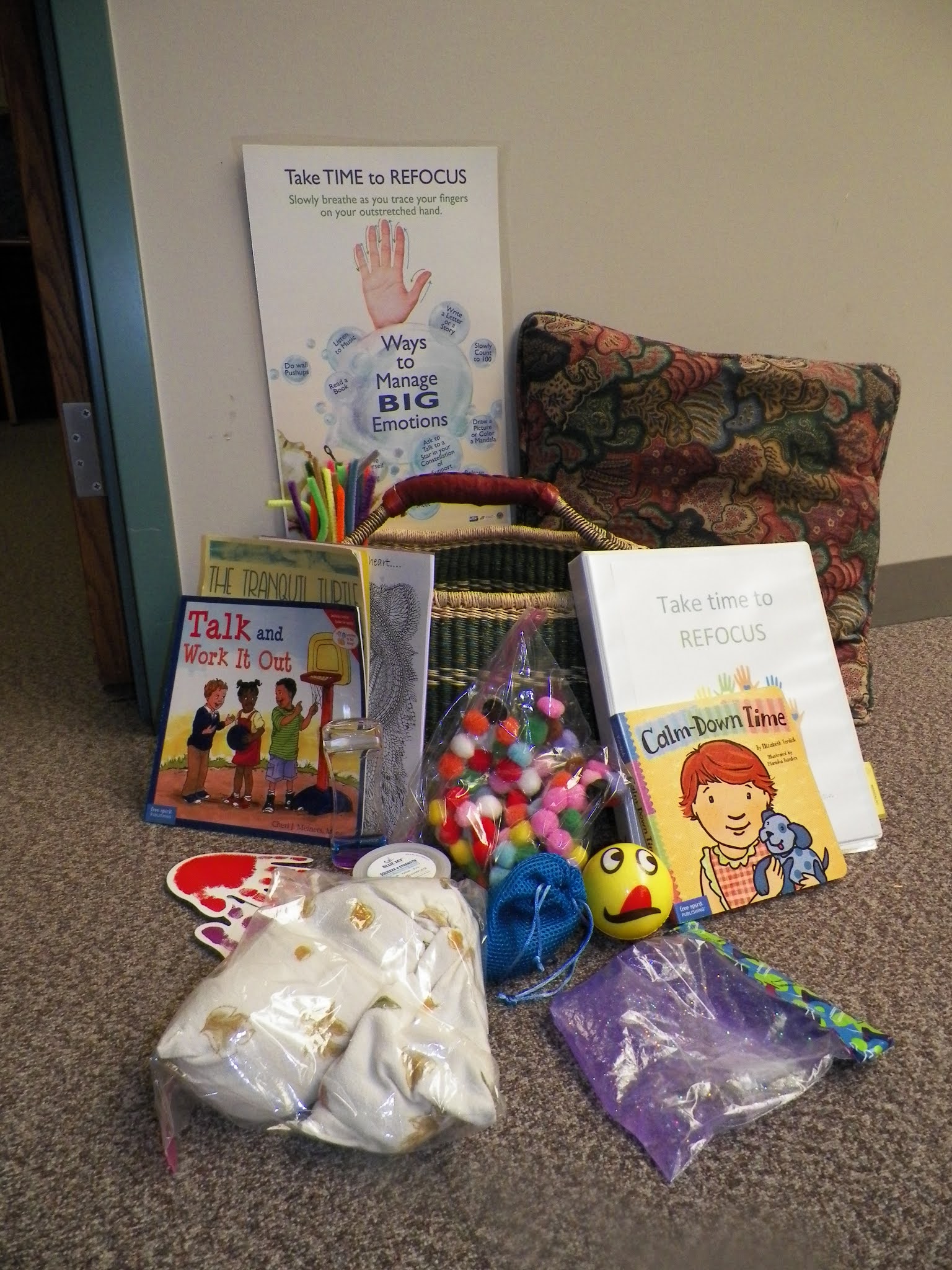
     d.  Set up a calming space somewhere in your house with some soothing items in it.  Encourage your child to seek out this space for 10 minutes when they need a regulation break to reset themselves for further learning.  It might include items such as a liquid timer or glitter jar, Hoberman's sphere, aroma therapy, stuffed animals, or mandalas to color.  Your child has a similar set up called a "Refocus Center" in their classroom.  Learn how to set up and use a Calming Corner at home in:  Establishing a positive tool for learning emotional self-regulation at home


     e.  Get outside EVERY day.  Fresh air, nature play, and exploration help us all feel refreshed and grounded.  Have free play, scavenger hunts, water fights, fort building, bird watching..... whatever fun our mountain weather permits.

     These practices are what teachers incorporate into the school day in order to reach and teach every child.  Teachers know that addressing anxieties and big emotions have to happen before other learning can take place.  All the caregivers who are now being asked to help with academics can use these same strategies to heal the uncertainty and chaos that is swirling around your children at this time.  Try one or more concrete steps under each Pillar and watch your child relax into a more optimistic and motivated mindset while displaying increased cooperative behavior.  

     These strategies help rewire their brain and nervous system so they can learn and grow.  However, don't expect overnight success.  A typical classroom of kids takes several weeks to settle into a routine each fall (pre-pandemic).  But by boosting each of these pillars in your home, remote learning will become easier to swallow for you and your child.  It might even become your child's best school year yet as they partner with their teacher and their parent in a whole new integrated way.  Feel free to contact us with questions or more information about these Four Pillars (kristen.kron@bvsd.org  or ann@teeninc.org).  GOOD LUCK!  


Wednesday, August 19, 2020

Simple Strategies for Creating Sanity during Remote Learning (PART ONE)

Simple Strategies for Creating Sanity during Remote Learning  


   Feeling Unmoored – Reflections on Grace

     Are you and your child feeling unmoored as you face remote learning this fall?  It may be extra challenging getting kids back into the routine of formal learning this year since it will look quite different from brick and mortar schooling.  Kids may feel discombobulated because they have just experienced 6 months of erratic sleep patterns, social isolation from friends, a nontypical routine, and been a fly on the wall while the adults in their lives express fear and overwhelm at the state of the world.  All this may undoubtedly affect their transition into remote learning.  

     At the same time children may be feeling out of whack, parents are experiencing their own set of stressors ~ fear of getting sick, concern for vulnerable family members, job loss or financial strain, endless uncertainty, disconnection from friends and extended family, the stress of increased togetherness, and a now a home learning role they weren't trained for.  Suffice it to say, we are ALL feeling more or less unmoored and overwhelmed as school begins.  

     With Covid-19 and instability as a backdrop, your child may be responding to the start of school in a dysregulated state.  Uncooperative behavior, meltdowns, and big emotions are to be expected from your child (and maybe even yourself as you manage your new role in home learning!)   Do what teachers do all year long ~ attend to the social emotional needs of your child.  Parents can draw from the myriad of simple strategies your child's teacher pulls from her toolbox every year to engage anxious, frustrated, and unmotivated children.  Use these same tools at home with your child.  

Four Pillars - Utility Vegetation Management Jobs | ACRT Services

     Parents can draw from these FOUR main PILLARS to create a healing response to children who have been traumatized and destabilized by the pandemic, increased family tension, and our current socio-political climate.  They are ~

          1.  Ensuring your OWN personal wellness (because selfcare is NOT selfish!)

          2. Creating predictability and fun routines,

          3. Creating a strong bond with your child while ensuring their sense of safety,  and

          4.  Helping your child regulate their emotions and behavior.

     Each of these necessary pillars provides specific ways to soothe our children and regulate their nervous systems so they can become curious and enthusiastic learners this fall:

1. Ensuring your own Personal Wellness. Here are some concrete steps we parents can take to ensure we feel grounded and supported during home schooling .... because emotionally distraught adults can NEVER calm a child  and help them settle into learning.  Our children will need our consistent, nurturing presence to lean on this year.  Choose from the list below (instead of turning to substances, Amazon purchases, pulling your hair out, or food binging to get through each week):    

     a.  At least once per day, start by pausing and mentally scanning your body for tight spots, identify how you're feeling in that moment, and take some time to stretch, go for a walk, or tighten and then release any tension in your shoulders, jaw, chest or stomach.  

Have you ever tried body scan... - Touched By Cedrice | Facebook

      b.  When feeling overwhelmed, stop and reframe your negative thoughts into ones with more hope, courage, humor and strength  (i.e. I can get through this last lesson by singing the directions to my daughter like a country western singer versus Geez, I hate this.)  Your thoughts will affect your emotional state. 

     c.   Set an intention to start and end each school day by putting yourself in a regulated state.  Join with your child in practicing mindful breathing during the NES Moment to Pause at the beginning of each day.  (Go to https://streams.thisisreboot.com/binatural/    Username: inhale@thisisreboot.com Password: justbreathe)    Then, end each day reflecting on what went well (a rose), what was challenging (a thorn), and setting a positive intention for the next day, i.e. I loved working on the puzzle today with my child (rose), but I was impatient when our internet kept going out during the math lesson (thorn).  Tomorrow, I'm going to email the teacher and ask for a Plan B if we continue to lose connection (intention).  

     d.  Commit to surrounding yourself with positive friends or to asking for encouragement from school counselor Kristen Kron (303-915-9194) or Mountain Strong Families Coordinator, Ann Sherman (ann@teensinc.org).    Talking with supportive friends helps build your resilience when executing your home learning role.  Reach out, but if no one is around ~ look in the mirror and use positive self-talk to encourage yourself to keep going.   Be your own best friend.

2. Create Predictability and fun Routines for your child. Provide your child with a daily routine they can count on.  Since so many things have changed and are uncertain, attention to your child's environment will help soothe them.

     a.  First and foremost, get yourselves back on a regular sleeping/wake up schedule.  Toddlers need 12 -14 hours of sleep/day.  PreK require 10-13 hours per night, while elementary kids need  9 -12 hours/night.  The link between a lack of sleep and a child's behavior isn't always obvious.  Kids become hyper, disagreeable, and have extreme changes in behavior.  Maintaining a regular sleep schedule will prevent many meltdowns.  

     b. Make the start of school a BIG DEAL for your kid.   Just like before, some kids will love picking out and arranging their school supplies, getting a new school outfit, having that special breakfast on the first day, or taking their picture.  These traditions can still occur.  Create some new meaningful rituals too.  Pick out and decorate a designated place at home for studying.  Encourage your child to go out the front door, ride their bike around to the back door, and walk into "school" each day.  Humans count on predictable patterns, seasonal rituals and celebrations to feel grounded in their lives.  

    c. Post a visual schedule each day for your child to refer to.  This will help them know what is coming down the pike ~ mindfulness, the order of subjects, recess breaks, meals or snacks, dance party, etc.  Include pictures of what they will be doing so younger children understand the flow of their day.  Dry erase boards work well for this visual schedule.  


     d. Help your child look forward to a morning ritual each day as a fun way of giving them special attention and connecting with them before you both get to work.  It fills their cup from the get-go every morning.  Maybe this means beginning their day by snuggling in bed together while talking about the day ahead (and before your pillow fight or tickle fest).  One family begins their school day with 3 traditions ~ the child reads a fun fact from National Geographic, picks a movement that the parent has to mimic, and then reviews the day's schedule.  Or, you can replicate the ritual of a morning circle which might include a song, game, or a clap-happy greeting that is precious and fun.  


     e.  Use repeated practices to slowly transition from one subject/activity to another.  Let your child know in advance when they have 10 minutes left before they are switching gears. Sing one of your favorite songs as you put on shoes to go outside, or use a chime or  responsive chant to refocus their attention before giving directions for the next activity  "Bump diddy bump, bump...... (they reply) bump, bump".  These repetitive routines for transitioning build muscle memory to help move the child from one activity to the next without a power struggle.  Offering a daily checklist also gives the child something to mark off before heading to the next activity.  

     f.  Explicitly tell your child what to expect before they need to do the assignment or activity by themselves.  "When we do something new, we'll first talk it through."  Pre-teach the steps until it is clear to them (ask them to repeat the steps back to you).  Another way of preparing children for remote learning is to "pretend" how the school day will go.  Have fun getting on a Zoom call with your child and letting them pretend to teach you.  Act out scenarios and provide clear expectations so your child feels confident to meet this new style of learning.    

     g.  Honor time for movement breaks and visits to your home calming center throughout each day.  When school work seems overwhelming, snuggle on the couch for 10 minutes while listening to music or do jumping jacks every 20 minutes.  These body and emotion breaks allow the child's nervous system to re-balance.  Knowing there will be breaks from learning helps your child pace themselves through their assignments.  

     Experiment with a couple of ideas from each Pillar above (the more the merrier your child will be).  Then, STAY TUNED next week for Part Two of  "Simple Strategies for Creating Sanity during Remote Learning."  

We'll cover two additional Pillars ~  (3) Creating and maintaining strong bonds with your child and (4) Helping your child self-regulate.   WE CAN DO THIS! 


Thursday, May 7, 2020

Creating Closure for our Children during this Wacky Year


"Crisis or transition of any kind 
reminds us of what matters most."   ~  Russell Ballard

     COVID- 19 has changed everything, but it hasn't changed our human yearning to recognize milestones in our lives~ significant beginnings and endings.  Among all the basic human needs, we crave tradition and predictability, social connection with others, celebration and meaning in our lives.  
     Due to school being cut short this year, and few opportunities to say farewell, children still desire a way to get their basic human needs met, regardless of the unusual circumstances.  Families can fill this void.  We may not be able to gather at the school building with the entire class and staff, but we can still ....  (how can you fill in that blank?)

     There is a reason why every culture marks key events and transitions in life ~  birth, naming ceremonies, baptism or bat mitzvah, coming of age, graduations, moving away from home, weddings, retirement, and the passing of life.  The ceremonies around these transitional moments allow us to grieve what has been lost, celebrate achievements and challenges, prepare for new roles, and ground ourselves in a new future.  
     Rituals around transitions show how our individual life cycle is part of a grander, natural design.  When done well, rites of passage connect us to our cultural heritage and the ancestors who came before us.  They solidify our own identity, help us create structure and meaning in the midst of an ever-changing, chaotic world.  They remove us from the ordinary flow of life and place us in a sacred space so we can balance the work of both our outer and inner lives.  They give us a sense of purpose.  
     Especially now, in the midst of a global pandemic and significant social distancing measures, we humans are yearning for meaningful rituals that help ground us and send us forth in hope.  Our children need some Rite of Passage at the end of their school year that helps them divide their lives into "before and after."  


"When one door closes, another opens.  
But all too often there is a long hallway in between."  
~ Rick Jarow

     Our children are stuck in the hallway right now, without a concrete way to reflect on their school year and celebrate their growth and relationships as they move forward.  When traditional institutions are unable to meet the cultural need for creating meaningful closure, family can still serve that role.  What we choose to create, our children will remember forever.  

"Incredible change happens in your life when you decide to take control of what you do have power over 
instead of craving control over what you don't."
~ Steve Maraboli


     Here are list of elements for designing your child's own Rite of Passage this year.  These elements help to foster the reflection, meaning, and closure that humans so desperately need.

1.  Gather a community.  A rite of passage needs witnesses, it demands an audience of supporters to recognize the transitional moment.  With concerns of social distancing, this could just be your immediate family.  It could be a small circle of friends gathered on spaced out picnic blankets in the middle of a field.  It could be a parade of cars passing by your home with horns blazing.  It could be relatives joining a ZOOM meeting to virtually read a story, sing songs, or cheer and applause the graduate.  One family replaced a guest list with cardboard cutouts of the important people in their child's life who could not be present.  Another family set photos of relatives and friends on chairs in the backyard.  

2.  Make it stand apart from ordinary life.  To derive power from a ritual, it must, in some way, stand apart from our ordinary lives.  Dress up.  Decorate.  Add flowers.  Drag the recycling bin out into the driveway and turn it into a podium.  This is not just another day in quarantine.  This is a big deal in your child's life.

3.  Select some symbols or metaphors for this moment.  Ask your child to select something that symbolizes the transition they are making.  They might choose a fitting metaphor ~  "I feel like I just walked out of a revolving door,"  "I'm looking out a window at a huge valley ahead,"  "I'm in a forest but I can't see the path."  Or spend some time selecting an insightful visual that represents how they see themselves right now.  Are they changing from a caterpillar into a butterfly?   Are they about to take the road less traveled?  Do they see themselves as having climbed a mountain and now they are descending?


     Typically, at the end of the 5th grade year at Nederland Elementary School, students spend time creating a personal statement of who they are at this moment in time.  They create an "I AM... poem" which is read to the community-at-large.  This poem helps define how they see themselves at this transitional moment.  Have your child share their personal statement, metaphor, or visual at your ceremony.  


"She knew this transition was not about becoming someone better but about finally allowing herself to become who she'd always been."   ~Anonymous


4.  Find the humor.  Always include humor.  Transitions can bring up feelings of joy, sadness, and anxiety.  These emotions can feel overwhelming as we witness a child moving from one stage to another.  Weave light-hearted humor through the rite of passage when appropriate.  Is there a way to collectively laugh about some of the earlier stages your child has gone through? (Slideshows of earlier hairstyles and hobbies capture this well.) Can your child find a way to laugh at themselves or some challenge they faced during the last year?  What was their favorite memory, their funniest moment?  Liven up the celebration with a quick scavenger hunt where everyone must quickly find something that reminds them of your child and bring it back to the event.  Share out what they selected.  Or, open up the ceremony to impromptu speeches by family members where they can help "toast" the graduate.

"Times of transitions are... an opportunity to purge, rethink priorities, and be intentional about new habits.  We can make our new normal any way we want."  ~Kristin Armstrong  

Regional climate shapes river topography – Physics World

5.  Letting go of the old.  Symbolize moving into a new stage by having your child take a tangible, personal artifact they have selected and release it, reinvent it, or ruin it.  They can use their hands to cut/scrape/burn/shred/or tear something.  They could light a candle at the beginning of the ceremony and then later blow it out.  They could send some intention inside of a balloon into the wind and let the wind carry it away.  They could bury an item in your yard, or let an item move downstream through water.  They could set it on fire in a campfire pit.  Some cultures have the child select a new name that they would like to be known as going forward.  Is there an old nickname they would like to leave behind?  Find some way to ritualize the transition from old to new, past to present.

Wilderness Youth Project Family Camp - Wilderness Youth Project

"Some changes look negative on the surface but you will soon realize that space is being created in your life for something new to emerge."  ~ Eckhart Tolle

6.  Reflect.  As a family, reflect on the advantages and disadvantages of leaving the past behind.  Honor the complex emotions at this juncture.  It is possible to  simultaneously feel excited and nervous.  We can feel tender and joyful in the same breath.  One of the most precious moments you can share with your child is to identify what characteristics they exuded when they were entering kindergarten.  Close your eyes and remember what they looked like, how they acted, and whether they were rambunctious? cautious? curious?  precocious?  determined?  Share a story or two about what your child was like at the beginning of their school journey.  Then reflect on how they can use these positive character traits as they move into their new role.  How can they cope and thrive by drawing from their personal traits in their new setting?  Demonstrate how their rich and vibrant character traits have been honed and will continue to serve them.  Frame your child's journey in a positive, hopeful light so they see the best in themselves as they embark.  See if you can get through this presentation without tearing up.

7.  Grand Finale.  Have guests stand in two lines facing one another.  Join hands and create a human arch for the child to pass through as you cheer or sing.  The beauty of a transition ritual is you can make it whatever you and your child need it to be.  When we are affected by major transitions in our lives,  rituals help us return to a sense of being whole again.  Your child will remember this quarantined celebration forever!   

"You must be the change 
you wish to see in the world."  
~Mahatma Gandhi